
Cothera Bioscience has developed several innovative anticancer candidates in the field of synthetic lethality, protein degradation and immunotherapy. Cothera Bioscience has applied for multiple international patents covering the drug candidates.
Sepantronium Bromide (PC-002)
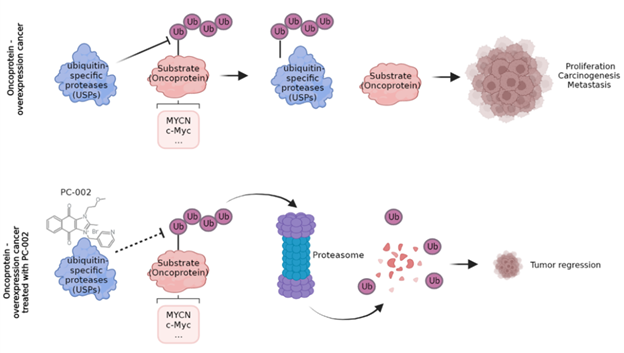
Cothera’s lead program PC-002 (also known as YM155, sepantronium bromide) is a first-in-class small molecule drug inhibitor of DUB, an enzyme family which removes ubiquitin from cellular proteins otherwise destined for degradation. With more than 50% of human cancers showing increased expression, Myc is regarded as one of the most important yet “undruggable” cancer targets. By inhibiting DUB that stabilizes the Myc protein in cancer cells, PC-002 selectively induces Myc protein degradation and cell apoptosis in Myc-dependent tumors. PC-002 may potentially target multiple cancer indications involving Myc dysregulation.
A paper1 describing PC-002’s mechanism-of-action has been accepted for publication on European Journal of Pharmaceutical Science.
1. Li et al. YM155 Inhibits Neuroblastoma Growth through Degradation of MYCN: A New Role as a USP7 Inhibitor, European Journal of Pharmaceutical Sciences (2022) doi: https://doi.org/10.1016/j.ejps.2022.106343
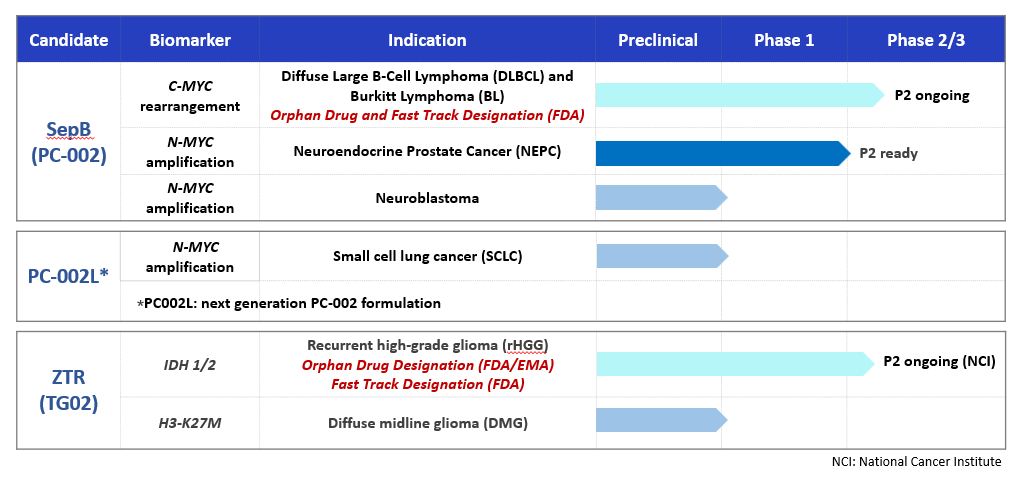
PC-002 is currently in Phase 2 studies for multiple indications and has demonstrated initial efficacy as well as safety in a monotherapy trial in relapsed and refractory high-grade B-cell lymphoma and Burkitt lymphoma patients with myc rearrangement (NCT05263583). Cothera presented the monotherapy study data at the 66th American Society of Hematology (ASH) annual meeting (December 2024).
Zotiraciclib (ZTR/TG02)
The second compound the company is developing is zotiraciclib (ZTR/TG02). ZTR is a potent oral multi-kinase inhibitors that crosses the blood-brain barrier. By targeting CDK9, ZTR degrades short-lived, anti-apoptotic oncogene proteins, disrupting the survival mechanisms of tumor cells (Nature Commun. 2024 May 30; 15:4616). Through PIM inhibition, zotiraciclib disrupts mitochondrial function, suppresses stress response pathways, and consequently increases vulnerability of gliomas with IDH 1 and IDH2 mutations. Such synthetic lethality supports zotiraciclib to treat patients with recurrent high-grade gliomas with IDH mutations as a monotherapy, avoiding the need to combine with other cytotoxic agents, thereby improving the patients’ quality of life (iScience 28, 112283 April 18, 2025).
ZTR has successfully completed a Phase 1b clinical trial sponsored and conducted by the US National Cancer Institute (NCI) that confirmed the safety and initially demonstrated effectiveness of ZTR in combination with temozolomide (TMZ) in patients with recurrent high-grade astrocytomas (Clin Cancer Res 2021 Jun 15;27(12):3298-3306). ZTR demonstrated initial objective response as well as safety in an on-going monotherapy trial targeting IDH-mutant high-grade glioma sponsored by NCI (NCT05588141).
Expanded Access
Cothera Bioscience is a clinical stage biopharmaceutical company developing therapeutics for previously undruggable oncology targets with high unmet medical needs. The team of clinicians, scientists and various professionals are working tirelessly to bring new medicines to patients as quickly and safely as possible. Our clinical-stage investigational agents, sepantronium bromide and zotiraciclib, are currently in human clinical trials undergoing careful evaluation of their efficacy and safety. Cothera believes that participation in clinical trials is the best way for patients to access these investigational medicines prior to approval. Thus, Cothera is not currently providing access to these therapies outside of clinical trials. Participation in Cothera clinical trials is voluntary, and the experimental agents are provided without charge. Cothera will continue to evaluate its policy of Expanded Access periodically as these experimental agents advance through the clinical development process.
If you have questions about our programs or eligibility for our clinical trials, please consult clinicaltrials.gov.